You Already Quit Your Resolution. Perfect.
How to change — actually.

Today is Quitter’s Day, the second Friday of January, when a large chunk of us have given up on the resolutions we made while drunk on the hope of a new year (or just drunk). If that’s you, fear not. Frankly, the whole idea that you might magically transform in the new year is a bit insane, considering it goes against the science of behavior change. The truth is a bit harder to sell: Lasting transformation generally happens incrementally, through extremely small steps, applied consistently, over a long time horizon.
The Buddhist monk Shunryu Suzuki puts it best: “After you have practiced for a while, you will realize that it is not possible to make rapid, extraordinary progress. Even though you try very hard, the progress you make is always little by little. It is not like going out in a shower in which you know when you get wet. In a fog, you do not know you are getting wet, but as you keep walking you get wet little by little.”
If you’d like to get damp with the fog of change, here’s a slightly more sustainable way to think about forming new habits, drawn from interviews I’ve done with behavioral experts like James Clear and Katy Milkman, way too many years of studying the science of betterment, and talking to elite athletes, performers, and other rigorously disciplined people. (This is also a topic we covered in yesterday’s episode of “excellence, actually.”)
To borrow a metaphor from my friend Brad Stulberg, it’s helpful to think of behavior change in terms of gravity.
A habit is a behavior that happens automatically — sort of like being attached to Earth: you don’t have to work very hard to do it, and, in fact, it takes a whole heck of a lot of effort to counteract it, which is why we love a dunk contest.
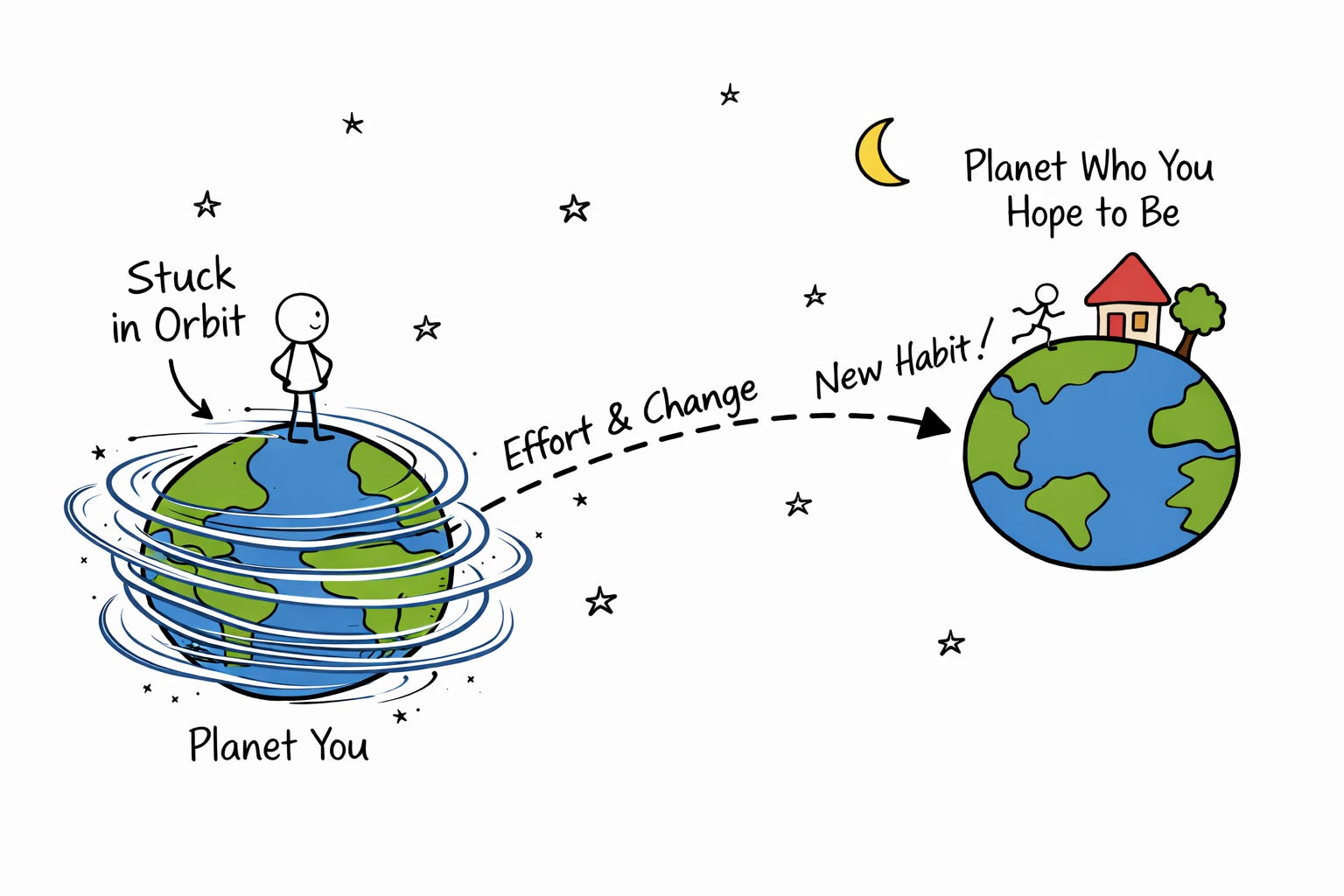
So at the risk of overstating it, changing a habit — kicking an old one, starting a new one — is akin to launching yourself out of the gravitational force of Planet You, across the galaxy, and into the warm orbital embrace of Planet Who You Hope to Be. This is why impulse buying a membership to Results gym isn’t likely to help you achieve exit velocity. It’s not that you’re “undisciplined” or “weak” — it’s that inertia is real.1
Behavior change, then, comes down to amplifying the gravitational pull of the behavior you’re trying to inculcate.
This is why the single best piece of advice about building new habits is to design an environment that facilitates the desired behavior, minimizing the need for willpower as much as possible.
Culturally, we love to valorize willpower. But a lot of times what looks like monumental willpower is actually just really good environmental design.
James Clear made this great point on a recent podcast: We look at professional athletes as paragons of discipline — and they are very disciplined. But also: their entire existence is structured in such a way as to facilitate peak performance. Their schedule, nutrition, workouts, recovery, travel — all of it is decided and prepared for them. Then there’s the team aspect. When you take willpower and you multiply it by structure and community, that is what creates discipline — and discipline is willpower made automatic.
If you’re not a professional athlete, this means that the onus of environmental design falls on you. This is where behavior change is most effortful: building better systems. But if you do it well, then it should mitigate the need for it going forward. And “doing it well” is going to be highly individual, based on what you need.
If, like me, you have the attention span of a Golden Retriever on mushrooms and you are particularly susceptible to being distracted by your phone, then changing your phone to grayscale isn’t nearly as good of a system as leaving it in another room entirely — or, if you absolutely need to have it on you (Do you, though? DO YOU?!), buying a Brick.2 Expectations, too, are a huge part of your environmental design. If you are someone — again, like me — who tends to overestimate how much you can do, then “start an arms/legs/off/push/pull weekly lifting split” is not as good of a system as “move for 20 minutes, three times week.” You want to do everything you can to make the gravitational pull of where you’re stuck be more like Mercury, less like Jupiter.
The big pitfall here is telling yourself you just need to [David Goggins voice] STAY HARD, because often the people you’re holding up as the cultural standard of “hard” are really just like medium-firm PLUS ruthlessly organized.
“In a lot of cases, the people who you're looking up to and thinking they have it all figured out, mostly they’ve figured out their own flaws,” says Katy Milkman, a behavioral scientist at UPenn. “It's more about the systems than about the people. Angela Duckworth has this wonderful study looking at people we think of as self controlled and showing it's actually that they have good habits. They’re not even using self-control—it’s just autopilot.”
Designing your environment for success is how you achieve liftoff.
At risk of butchering this metaphor, consider that Planet You has two particularly dangerous elements in its atmosphere, ones that can corrode your spaceship and keep you from exiting its orbit: Discouragement and Apathy.
How do you guard against them? Consistency.
How do you stay consistent? Have a resolution (or choose a new habit) that is both outcome-based and values-driven.
If your resolution is “run a 5K" (outcome-based) then when it’s January 16th, and your 5K isn’t until March, and you’ve had a terrible day at work, and now it’s raining, and your couch-to-5K plan says “20-minute walk/jog,” and hey, isn’t there a new season of [insert literally any show]… you’re not getting out the door. And oh damn, look at that, it’s raining for the next two days, and well, you already missed one day, and this new season of [show] is so good… Failure to launch.
However, if your resolution is “I want to move more” (values-driven), well, that’s easy enough on a rainy day. Get down and do some push ups, throw in a few Downward Dogs while watching [show], maybe even walk up and down the stairs — gold star! But now it’s March 2nd, and it’s been fun to move, but also, you’re sore in places you haven’t been before, and what’s all this for anyway? You’re tired of the StairMaster, and hot yoga’s pretty expensive, and most of the people in that run club were insufferable… Stuck in orbit.
But if your resolution is “I want to move more and, you know what, running a 5K seems like a fun challenge to work towards” … you’re unstoppable; you’re in outer space; you’re Neil Armstrong, baby.
Values push you out of one orbit by making small wins achievable and tangible, and a big outcome or goal pulls you into the other by giving you a spot to aim for on the horizon.
Together, they keep you consistently moving in the right direction.
The last step of behavior change: Beware the arrival fallacy.
Don’t assume that achieving the big goal or the outcome will bring you lasting satisfaction, or that it even signals the end of the work.
“One of the most common questions I get is, ‘How long does it take to build a habit?’” James Clear told me, back in 2018. “And the assumption behind that question is, ‘How long does it take until I can stop working? How long until I don’t have to put effort in anymore?’ The honest answer is forever. Because if you stop doing it, then it’s no longer a habit. And so we need to start looking at changes like this as a lifestyle to be lived, and not a finish line to be crossed.”
As Clear writes about in his wonderful book Atomic Habits, true behavior change is about a shift in identity, and that shift might take years.
That doesn’t mean you need to figure out exactly who you want to be. That’s a lot of pressure and January’s bleak enough without layering on some existential dread. (Though probably a good thing to take stock of at some point!)
Maybe you just feel like waking up without back pain, or starting to crochet, or reading poetry. Whatever it is, the ultimate point is that whatever you pick, the daily actions of doing it —of going out into the fog and getting damp — will begin to shape who you are.
In fact, I’d argue that it’s not so much that we change our behavior, but that our behaviors change us in the process of doing them. And the best news of all is that time is a construct, so you can choose them at any time, even today, a day dedicated to quitting.
The last time I opened a physics textbook was almost 14 years ago and it was in a college class colloquially known on campus as “Football Physics,” not because it was about the physics of football but because of the generous, end-of-semester curve applied by the professor — great for football players and English majors (me). I believe my final grade was something like 109 out of 100, which is not a reflection of my mathematic aptitude but a reflection of the curve’s heft. Anyway, what I’m saying is please forgive me if my understanding of inertia and gravity isn’t Newton-esque in its accuracy.
Seriously, buy a Brick. It’s worth it. And they’re not even paying me!