Simplify Your Life
If "anxiety is the dizziness of freedom," then less freedom means less anxiety... right?


In 1960, A publisher at Random House bet a writer $50 that he couldn't produce a children's book using just 50 distinct words. That writer was Dr. Seuss, and the resulting book was Green Eggs and Ham, which has gone on to sell more than 200 million copies.
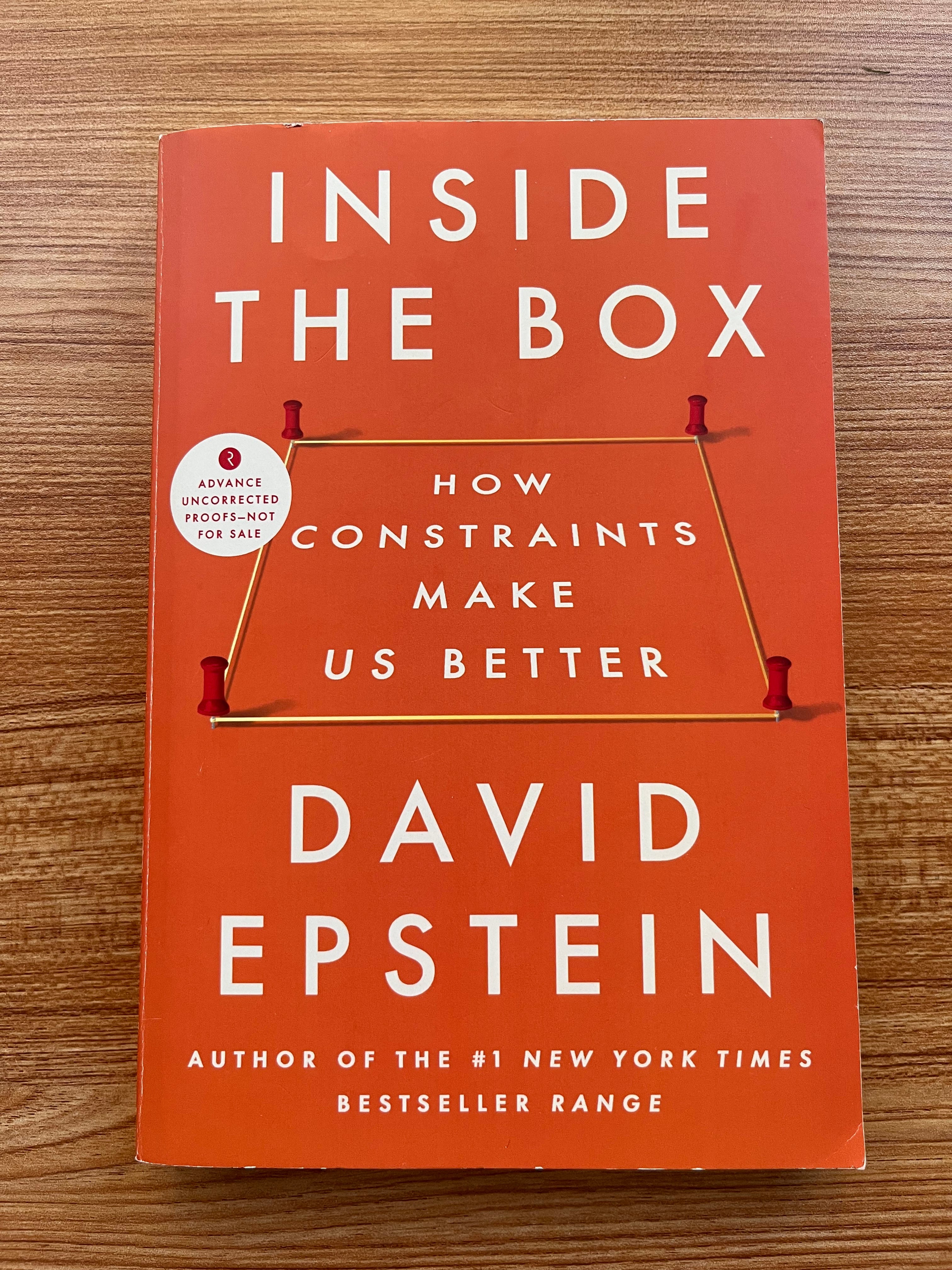
Sometimes, limits aren't a bad thing. In fact, they often lead to unexpected breakthroughs in creativity, productivity, and satisfaction. This is the message at the heart of David Epstein's new book, Inside the Box: How Constraints Make Us Better.
And since this is something elite performers know well—instead of adding more or keeping their options open, they’re whittling down to what matters most—we had David on our most recent episode of “excellence, actually” to see what he could teach us about making use of productive limits.
1. The Paradox of Choice
For most of human history, Epstein says, the idea that we’d need less freedom was laughable. Sometime in the 19th century, though, you see thinkers start talking about the feeling of being overwhelmed by possibilities.
In his book The Concept of Anxiety, Søren Kierkegaard famously wrote “anxiety is the dizziness of freedom.” When all options are open to you, choosing one can be deeply intimidating. That means that in our modern world of choice and convenience, we are increasingly dizzy. Epstein says this is exacerbated by the advent of A.I. and productivity hacks, all of which perpetuate the illusion that we can do it all, if we’re just properly optimized.
Epstein points out that not only is this a lie—our attention and cognition is still a fundamental bottleneck (see #5)—but psychologists, who prefer the term “maximizing’ instead of “optimizing,” find that this leaves people less happy and more prone to regret.
So what to do?
2. Try Satisficing
Herbert Simon was against optimizing. (Mind you, this dude was trained as a political scientist but ended up winning the highest awards, including the Nobel Prize, in computer science, economics, and psychology.) He noted that in their attempt to make the most optimal decision, humans attempted to gather more information than they could reasonably process.
So he introduced the concept of satisficing (satisfy + suffice), which suggests that once a threshold of acceptability is met, a decision should be made. For instance, if you’re looking for seven things in an apartment, but you’d be happy with five, and you find a unit with five, you should take it instead of holding out for one with six or seven.1
This decision-making tool is also useful as an antidote to perfectionism. When it comes to completing a project, it’s often better to focus on making it good enough rather than perfect. “It’s not about having low standards,” says Epstein. “It’s about having any standards other than best imaginable.”
3. Take it from a coaching legend: Do less to do more
During his research, Epstein spoke to someone who had been an assistant coach under legendary Alabama coach Nick Saban. At one point, Saban became frustrated by how much time practicing plays was eating up in the day. So he gave his coaches a limit. He told them they could practice seven offensive play and seven defensive plays—that was it. “It led them to think: what are the things that we really want to work on?” Epstein said. “With these ultra constraint-based things, it slows you down, but it really makes you think hard.”
4. Constraints You Can Use
Here are three constraints Epstein says he’s found useful in his own life:
Write a one-page press release: Epstein got this from Tony Fadell, the co-founder of Nest. For any project, write a one-page press release about the project before you start. It forces you get clear on what really matters, and what success would look like. Epstein says he uses this not just for work, but for starting a new habit or trying to change his behavior in some way.
Time-bound your activity: In college, I majored in English, and minored in both history and philosophy (we call that The Holy Unemployability), so I wrote a lot of papers. I liked writing papers, but I also agonized over them. Which is why I always enjoyed in-class essays. They were time-bound, which meant I didn’t have time to think and think and think. I had forty-five minutes to get something down. Epstein says he now uses a similar forcing function in his life by asking himself, “If I had to do this in half the time, how would I do it?” (It reminds me of a question Tim Ferriss says he often asks of himself: What would it look like if this were easy?)
The One Value test: Epstein says that in creating a culture, leaders and coaches often overcomplicate things. “Complexity steals clarity,” says Epstein. “If you’re a leader or coach trying to build a culture, ask yourself, if I could choose more of only one behavior, what would it be?”
5. Mono-Tasking is a Superpower
Multi-tasking is a prime example of the attempt to optimize backfiring. Epstein cites research showing that, on average, workers check their email 77 times a day. All that toggling meant they were working at reduced cognitive capacity, in part because of something called the Ziegarnik Effect, a psychological tendency to remember incomplete or interrupted tasks better than finished ones.2
If you’re constantly remind yourself of all the stuff you haven’t done, you’re making it harder to focus on the one you are currently doing. One psychologist compares switching from one task to the act of constantly writing on and erasing a whiteboard: there’s more and more residue leftover from what came before.
Epstein is a big proponent of mono-tasking or batching. Instead of getting in and out of your inbox 77 times a day, set aside a time-bound period in which you just do email for that time (to the extent that your job and circumstances allow for this, of course). In fact, in our age of constant distraction, just doing only what you’re doing is a good practice not just for all types of work, but for many parts of life, too.
If you want to hear more from David Epstein, check out his book and our full podcast episode with him. (And if you enjoyed this post, you’ll probably get a lot out of this recent conversation with Cal Newport about how to un-break your brain.)
Other posts you might enjoy:


A related concept I also learned about from Epstein is called Fredkin’s Paradox: the more similar two alternatives are, the more time and energy we spend deciding between them. This is inefficient, of course: because the options are so similar, the decision is less consequential. and should require less time, not more.
This isn’t necessarily a bad thing. It’s often what leads to creative breakthroughs. You start working on a project, then you go off and do something else, but your brain keeps working the problem out in your head, and then—BOOM!—out of nowhere you have an epiphany.
Great post! Thanks Clay
Excited for the day I can satisfice and push out a post like this. And hype to listen to the episode.
Quick Q: Does "good enough" ever become a rationalization for not doing our best work, or is it just a matter of how we define our own standards?